
Your Condo’s Safety Net: What California Condo Insurance Really Covers
Buying a condo in California feels different. You own your unit, sure, but you also share walls, a roof, and common areas with neighbors. This unique setup means your insurance needs aren’t quite like a traditional homeowner’s policy. Many people think their HOA’s insurance covers everything. The short answer is no. The real answer is far more complicated, especially here in the Golden State.
Understanding what your condo insurance—often called an HO-6 policy—actually protects is key. It’s not just about covering your couch. It’s about protecting your biggest investment from the unexpected. And in California, “unexpected” often means wildfires, earthquakes, and a shifting insurance market.
The HO-6 Policy: Your Personal Shield
Think of your HO-6 policy as the personal layer of protection that sits *inside* your HOA’s master policy. It picks up where the association’s coverage leaves off. What does that look like? Let’s break it down.
Your Unit’s Interior: Walls-In Coverage
Most HO-6 policies cover the interior of your specific unit. This is often called “walls-in” coverage. It means your policy protects things like your drywall, flooring, cabinets, fixtures, and built-in appliances. If a pipe bursts in your wall, or a kitchen fire damages your countertops, your HO-6 policy is usually the one to step in.
But here’s the thing. Not all HOA master policies are created equal. Some are “bare walls-in,” meaning they only cover the basic structure of the building and nothing inside your unit. Others are “single entity” or “all-in,” covering more of the original fixtures and finishes. You absolutely need to get a copy of your HOA’s master policy and its Declarations of Covenants, Conditions, and Restrictions (CC&Rs) to understand this distinction. It makes a big difference in how much dwelling coverage you need on your HO-6. Many condo owners skip this step. Big mistake.
Your Personal Belongings: What’s Yours is Covered
This part is straightforward. Coverage C, or personal property coverage, protects all your stuff inside your condo. Furniture, clothes, electronics, artwork, dishes—you name it. If it’s yours and it’s damaged or stolen, your HO-6 policy is designed to replace it.
Imagine a kitchen fire in your unit. Your walls get scorched, your cabinets melt, and your prized collection of vintage vinyl records goes up in smoke. Your HO-6 covers the walls and cabinets (dwelling coverage), and it covers the records (personal property). It’s that simple.
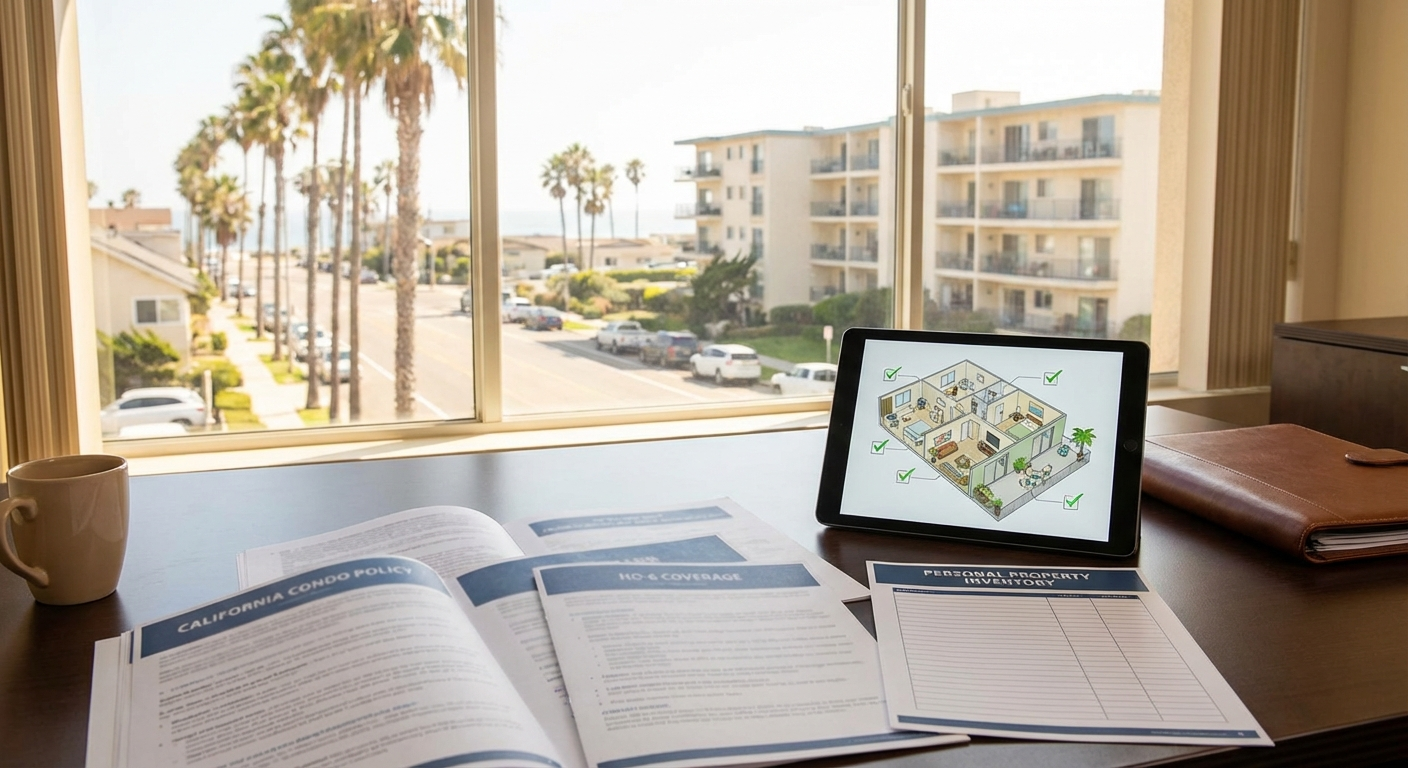
Often, people underestimate the value of their belongings. Walk through your home with your phone, take a video. Open every closet, every drawer. You’ll be surprised how quickly the numbers add up.
Temporary Living Expenses: When Home Isn’t Home
What happens if a fire or flood makes your condo unlivable for a few weeks or months? Where do you go? Loss of Use coverage (Coverage D) steps in here. It pays for your temporary housing—a hotel, a rental apartment—and even extra living expenses like meals out, laundry services, or pet boarding.
This coverage is incredibly important, especially in high-cost areas like Los Angeles or Orange County. Finding a place to stay on short notice isn’t cheap. Your policy makes sure you’re not out on the street or draining your savings while your home is being repaired.
Liability Protection: Accidents Happen
Picture this: A guest slips on a wet floor in your kitchen and breaks an arm. Or your bathtub overflows, flooding the unit below you. Personal Liability coverage (Coverage E) protects you if you’re found legally responsible for someone else’s injury or property damage. It covers legal fees, court costs, and any judgments or settlements up to your policy limits.
This isn’t just about guests. It’s about anything originating from your unit that causes harm or damage. If your washing machine hose bursts and ruins your downstairs neighbor’s newly renovated living room, your liability coverage is what pays for their repairs. Most people carry at least $300,000 in liability, but often $500,000 or even $1 million is a better idea, especially in California’s litigious environment.
Medical Payments: Small Injuries, Big Help
Coverage F, or Medical Payments, is for smaller injuries that happen to guests in your condo, regardless of who’s at fault. Think of it as a goodwill gesture. Someone trips over your rug, gets a nasty cut, and needs stitches. This coverage can pay for their immediate medical bills without having to determine liability. It’s usually a smaller amount, like $1,000 or $5,000, but it can prevent a minor incident from escalating into a liability claim.
The HOA Master Policy: The Big Picture
You can’t talk about your HO-6 without talking about the HOA’s master policy. It’s the foundation. This policy covers the building’s structure, common areas (like lobbies, gyms, pools, shared roofs), and the liability for accidents that happen in those common spaces.
As we touched on, there are three main types:
* Bare Walls-In: The HOA covers the main structure, exterior walls, and roof. Everything inside your unit, from the drywall to the paint, is your responsibility. This means you’ll need higher dwelling coverage on your HO-6.
* Single Entity (or Original Specifications): This policy covers the structure and the original fixtures and finishes within your unit. If you upgraded your kitchen cabinets, though, those upgrades might not be covered by the HOA’s policy.
* All-In (or All-Inclusive): This is the most comprehensive master policy. It covers the structure, common areas, and all fixtures, including any improvements or upgrades inside your individual unit. If your HOA has this, your HO-6 dwelling coverage needs will be lower.
Why does this matter so much? Because the gap between what the HOA covers and what your HO-6 covers is where you could lose a lot of money. Karl Susman at California Condo Protection, CA License #OB75129, always stresses getting a copy of your HOA’s master policy. It’s the first step in getting the right HO-6 coverage.
Special California Considerations
Living in California means dealing with unique risks. Your HO-6 policy needs to reflect that.
Wildfire Woes
From the hills of Ventura County to the canyons around the Inland Empire, wildfires are a constant threat. Standard HO-6 policies typically include fire coverage. But if your condo is in a high-risk brush area, getting coverage can be tougher. Insurers like State Farm and Farmers have pulled back from certain parts of the state. This means you might find fewer options or face higher premiums.
Even if your building doesn’t burn, smoke damage is real. Ash and smoke can infiltrate your unit, damaging electronics, furniture, and air quality. Your HO-6 should cover this.
Earthquake Protection: A Separate Beast
California is earthquake country. Everyone knows it. But here’s something many condo owners miss: standard HO-6 policies *do not* cover earthquake damage. Not a single crack. You need a separate earthquake policy, often purchased through the California Earthquake Authority (CEA) or a private insurer.
These policies can have high deductibles—often 15% or 20% of your dwelling coverage. That means if you have $200,000 in dwelling coverage, your deductible could be $30,000 or $40,000. It’s a big number, but it’s better than losing everything.
Loss Assessment Coverage: When the HOA Needs Help
Sometimes, the HOA’s master policy isn’t enough to cover a major loss, or it has a high deductible. When this happens, the HOA can “assess” each unit owner a portion of the uncovered costs. Say a massive storm causes $1 million in damage to the building’s roof, but the HOA’s policy has a $250,000 deductible. They might assess each unit owner $5,000 to cover that deductible.
Loss Assessment coverage on your HO-6 policy can pay for your share of these assessments. This is a critical coverage to have, especially in older buildings or areas prone to natural disasters. Without it, you’re on the hook for that cash out of pocket.
What Drives Your Premium Up?
Honestly, a few things really move the needle on your HO-6 premium.
* Location: High-risk wildfire zones, coastal areas, or places with higher crime rates will cost more.
* Building Age & Condition: Older buildings with outdated plumbing or electrical systems are riskier.
* Claim History: If you’ve filed multiple claims, expect higher rates.
* Coverage Limits & Deductibles: More coverage means higher premiums. A lower deductible means higher premiums.
* HOA Master Policy: If your HOA has a “bare walls-in” policy, your HO-6 will need to pick up more of the slack, meaning a higher premium.
The California insurance market has been tough lately. Premiums jumped 40% between 2022 and 2024 for many homeowners and condo owners. Changes to the FAIR Plan and the slow pace of Prop 103 reforms mean getting affordable coverage takes work. That’s why talking to an experienced agent like Karl Susman is so important. He knows the California market inside and out.
Finding the Right Fit
Getting the right condo insurance isn’t about finding the cheapest policy. It’s about finding the *right* policy. One that truly protects your investment and your peace of mind. You need an agent who understands the nuances of California’s insurance market, the different types of HOA master policies, and your specific needs.
Don’t wait until disaster strikes to figure out you’re underinsured. Get a clear picture of your risks and your options.
Ready to see what your personalized condo insurance could look like? Get a fast, free quote today: Get Your Condo Insurance Quote
Or maybe you have questions about your HOA’s master policy and how it affects your personal coverage? Karl Susman and his team at California Condo Protection, CA License #OB75129, are available to help. Give them a call at (877) 411-5200.
Frequently Asked Questions About California Condo Insurance
Does my HOA’s insurance cover my personal belongings?
No, almost never. The HOA’s master policy covers the building structure and common areas. Your personal belongings inside your unit—furniture, clothes, electronics—are covered by your personal HO-6 condo insurance policy.
Do I need earthquake insurance for my condo in California?
Standard HO-6 policies do not cover earthquake damage. If you want protection against earthquakes, you’ll need to purchase a separate earthquake insurance policy, typically from the California Earthquake Authority (CEA) or a private insurer.
What is “loss assessment” coverage and why do I need it?
Loss assessment coverage protects you if your HOA’s master policy isn’t enough to cover a major loss, or if the HOA has a high deductible. In such cases, the HOA can assess each unit owner a portion of the uncovered costs. Your loss assessment coverage pays for your share of that assessment, up to your policy limits.
How much personal liability coverage should I have?
Most experts recommend at least $300,000 in personal liability coverage, but many people in California opt for $500,000 or even $1 million. This protects you if you’re found legally responsible for someone else’s injury or property damage. The specific amount depends on your assets and risk tolerance.
Can my condo insurance premium go up if my neighbor files a claim?
Not directly, but indirectly, yes. If your HOA files multiple claims against the master policy, or if the building is in a high-risk area for things like wildfires, the overall insurance costs for the association can increase. This could lead to higher HOA dues, which indirectly affects your costs. Your individual HO-6 premium is primarily based on your unit’s risk factors and your own claims history.
Looking for a quote or just have more questions? Don’t hesitate to reach out to Karl Susman at California Condo Protection, CA License #OB75129, at (877) 411-5200 or get an online quote now: Get Your Condo Insurance Quote
This article is for informational purposes only and does not constitute financial advice.